Meet the Air Team: Dani Serna, Air Quality Work Lead
Published on January 15, 2026
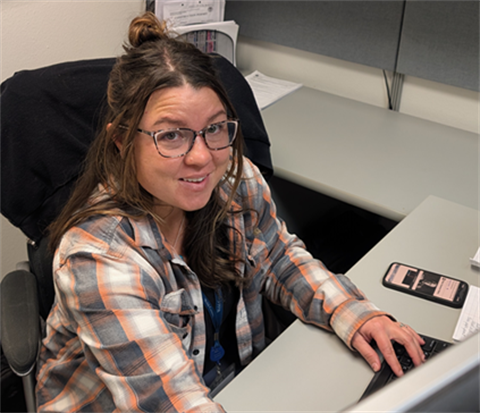
When Weld County residents have questions about smoke on the horizon, dust blowing across a worksite, or a strange smell drifting through the neighborhood, there’s a good chance their concern will eventually land on the desk of Dani Serna.
As the Air Quality Work Lead contracted to support the Colorado Department of Public Health and Environment’s Air Pollution Control Division, Serna’s work sits at the intersection of science, regulation, and everyday life.
“I basically handle all the regulatory compliance work for the Air Pollution Control Division, which is the state air pollution arm,” Serna explained. “I do inspections, complaint investigations, review and issuance of burn permits, illegal burning cases, CFC inspections, compliance assistance for sources — that’s what I do.”
In plain terms: when someone is worried about what they see or smell in the air, Serna is often the one who shows up to figure out what’s going on.
Trained to see what others miss
Behind Serna’s calm explanations and detailed investigations is a long list of training and certifications.
Serna began her AQ journey in Maricopa County, Arizona, transferring from environmental health to air quality in 2017. That county has one of the most stringent air quality programs in the country, and Serna arrived in Weld County already deeply trained in field inspections and enforcement.
Over the years, Serna has maintained and expanded a wide range of credentials, including: mining safety training, multiple FEMA courses, Colorado annual odor certification, EPA advanced air quality inspector training and EPA Method 9 Opacity certification — a visible emissions observer standard to accurately read smoke and dust opacity with the naked eye.
All these skills mean that when Serna stands on a roadside watching dust blow, analyzes smoke from a stack, or measures odors outside a facility, those observations aren’t just opinions — they’re hard data that can hold up in enforcement cases, if needed.
Turning complaints into answers
Air quality complaints can look very different from one call to the next. Those concerns can be about:
- Smoke from open burning or stacks
- Dust from construction, roads, or commercial sites
- Odors from industrial, agricultural, or other sources
“I get a wide range,” Serna said. “Some people call and they’ve seen nothing, smelled nothing, heard nothing. They just know something’s happening, maybe a construction project or industry nearby, and they’re concerned.”
From there, Serna starts unraveling the problem. For visible emissions like dust or smoke, that may mean going on site, observing conditions, and comparing what’s happening to state standards and permit requirements. For odors, it’s often more complicated.
“Odor is a difficult one. Here in Weld County, we have lots of smells coming from lots of places,” Serna said. “We have natural phenomena, especially agricultural stuff, that can smell like something harmful, like an ammonia smell, and it’s actually completely natural. Most of the things that are super hazardous to us are not detectable with the human nose.”
Because of that, Serna spends a lot of time both investigating and educating — looking for real sources and potential violations while also helping residents understand when a smell is more of a nuisance than a health threat.
Dust, smoke, and what’s exempt
Dust is another frequent concern — and another area where Serna’s job requires both careful evaluation and explanation.
“Here in Weld, we have so much agriculture. A lot of ag is exempt from any kind of blowing dust situation,” Serna said. “Those exemptions extend all the way up to the federal level, reflecting both legal decisions and practical realities.”
For other operations, the rules are stricter.
“Any commercial operation that’s not exempt has to meet an opacity standard or have permit requirements that further dictate controls and standards they have to meet,” Serna said.
That can include mining operations, oil and gas sites, manufacturers, surface coating operations, and more — each with its own rules and thresholds.
If Serna finds a violation, she will document it and forward a report to the state. Because permits are issued and enforced at the state level, enforcement action is handled by the Air Pollution Control Division, with Serna serving as a key witness and technical resource.
Burn permits: knowing when to call
While many of Serna’s investigations start with a complaint, another big part of the job is helping residents do things legally — especially when it comes to burning.
“Burn permits are probably the number one area where I talk with the public,” Serna said. “
There are two main categories for burning:
- Exempt burns, which do not need a permit
- Non-exempt burns, which do need a permit
Exempt burns include:
- Small recreational or social fires used for warmth or cooking
- Household-size burning of clean paper or cardboard (not from a business and free of plastics or paint)
- Ditch and water conveyance burning
- Agricultural burns of commercial crops or livestock pasture
But just because a property is in an agricultural zone doesn’t mean every fire is “agricultural.” It has to do with purpose and materials, Serna emphasized. When a fire goes beyond a small campfire-size social burn and becomes a way to dispose of branches, leaves, or other materials, it may require a general open burn permit. Those permits allow for the burning of clean, natural green waste, like slash, tree branches, and yard debris, but not construction lumber, pallets, or furniture.
One key point Serna stresses: if someone sees a fire that looks dangerous, their first call should be to the fire department, not to air quality.
“I don’t put out fires,” Serna said with a laugh. “They’ll let me know.”
Walking the line between public, science, and policy
Serna’s favorite part of the job is the variety of people and industries she works with.
“A lot of industries are actually really good to work with. They’re usually transparent and excited to show you how things work. It makes your job easier as an inspector.” She said.
The most challenging part? Public perception, and the pressure that can come when emotions and science collide.
“The public perception of what air quality regulation actually is, and what the actual problems are, can be hard,” Serna said. “We have to stay non-biased. We toe the line between the public and the industry to gain compliance.”
Serna points to something called the “illusory effect,” which is the idea that hearing the same claim over and over can make it feel true, even if it hasn’t been verified. For Serna, the key is always coming back to the regulations and the evidence.
“We’ve had cases where we’ve been inundated with the same complaint from different people,” Serna said. “But it doesn’t mean it’s true, not until we see it or validate it for ourselves.”
A human approach to policy enforcement
At the end of the day, Serna’s job is both highly technical and deeply human.
“I can’t dictate for somebody what is worthy of a complaint,” Serna said. “My job is to determine whether sites are in compliance or not.”
Serna sees her role as helping bridge the gap between what people feel and what science and regulations show. Helping residents understand the real situation when fears outpace the facts, and pushing for accountability when the rules aren’t being followed.
Together with colleagues who focus on air quality policy, analysis, and legal strategy, Serna is part of a broader team working to understand and protect Weld County’s air.